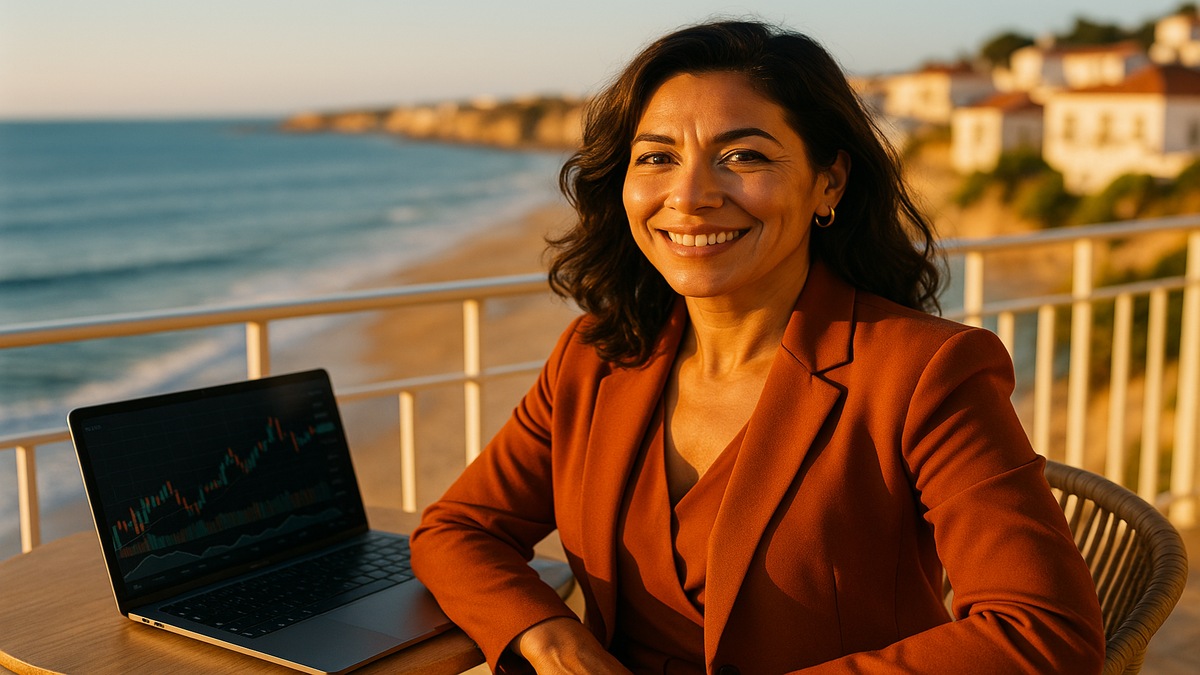
For most of her adult life, Delyanne Barros believed the path to financial security ran straight through a mortgage. Chasing property in one of America’s most brutal housing markets, she watched deal after deal collapse — and eventually asked herself a question that would change her entire future: what if buying a home wasn’t the only way to build real wealth?
That single shift in thinking led Barros away from real estate and toward the stock market. Today, at 43, she has cleared six figures of student debt, retired herself and her mother from full-time work, and now lives in a beachfront condo in Portugal. Her message to anyone who feels they’ve missed the boat: it’s never too late to begin.
A late bloomer who thought her 401(k) was a savings account
Barros didn’t understand the basics of investing until she was 37. Born in Brazil and brought to the United States at age eight, she built a successful career as an employment lawyer — but her financial literacy lagged far behind her paycheck.
“I started contributing to a 401(k) when I was 28, but I thought it was a savings account,” she says. “I did not understand that it had anything to do with the stock market.”
At the time she was earning $180,000 a year as an attorney editor for Thomson Reuters while carrying roughly $150,000 in student loans. Priced out of New York City and exhausted by failed real estate attempts, she started questioning the advice she’d absorbed for years.
“In the minority community, we’ve been told for so long that owning a home is the way to build wealth,” she says. “I just started thinking: ‘There’s got to be another way, right?’”
Six months down the personal finance rabbit hole
Barros spent half a year consuming everything she could find about money, taxes, and investing. What surprised her most was how accessible it all turned out to be.
“It was mind-blowing,” she recalls. “I didn’t know that you could manage your own investments. I learned that there was a pathway to retiring early — which was great for me because I was completely miserable as an attorney.”
A turning point came when she found other women and people of color openly discussing money online. “When you only see white men talking about these things, you feel like an outsider,” she says. So she began documenting her own journey on Instagram, and an audience quickly formed. Then the pandemic hit, sending millions of people home and hungry to learn — a perfect moment for her to teach.
How she built her portfolio from scratch
Barros began maxing out her 401(k) in 2019. She’d saved $100,000 for a down payment, but once she abandoned the property dream she moved $40,000 into a brokerage account. Three months later, the Covid-19 market crash arrived — and instead of panicking, she doubled down.
“I had researched and prepared myself,” she says. “I was able to just ride that through and have faith that the market was going to come back. In fact, I started dumping even more money into the market.”
Her advice on account choice is straightforward: if you want to retire early, a taxable brokerage account gives you flexibility to withdraw before the standard retirement age without penalties. If early retirement isn’t your goal, traditional retirement accounts may deserve priority.
What her holdings look like today
Barros keeps things deliberately simple — “boring as hell,” in her words:
- 85% in S&P 500 and international index funds
- 15% in individual stocks
- $526,000 across retirement accounts (401(k) and traditional IRA)
- Over $1.5 million in her brokerage account
By her math, if she never adds another dollar to her retirement accounts, compound growth at a conservative 8% could push them to roughly $2.6 million by the time she turns 59½. From her brokerage, she plans to withdraw about 4% a year — around $60,000 — to cover her living costs and support her mother, with any extra coming from her business.
Her skepticism check for anyone promising quick riches: “If somebody comes to you and is like, ‘I can get you a 20% return per year,’ your BS meter should be going off, knowing that with the S&P 500 you can make 8% or 10% a year on average.”
Traditional IRA vs. Roth IRA, explained simply
Barros breaks down the difference many people find confusing:
- Traditional IRA: Contributions go in pre-tax, grow tax-free, and are taxed when you withdraw.
- Roth IRA: You pay taxes upfront, then the money grows and is withdrawn completely tax-free.
Which is better? It depends on your tax bracket now versus later. If you’re earning at the peak of your career today, a traditional IRA lets you cut your current taxable income. If you’re just starting out and expect to earn more down the line, a Roth locks in your lower tax rate now.
Reuniting a family across two continents
The financial freedom Barros built made possible something she’d wanted for decades. Her mother returned to Brazil in 2005 and, Barros says, would not have qualified for a visa to come back to the US. Three years ago, the two moved together to a beachfront condo in Portugal.
“It’s been a lifelong dream to reunite with my mother,” she says. “We’d been apart for 20 years living on different continents.”
Is it too late to start investing?
Barros is adamant that a late start doesn’t mean a lost cause. “For a lot of people, most of their earning power is between the ages of 35 and 55,” she says. “You can make up for lost time.” Higher income in your 40s and 50s often means you can invest larger monthly amounts and close much of the gap.
Frequently asked questions
What is an index fund and why does Barros recommend it?
An index fund tracks a broad market benchmark like the S&P 500, spreading your money across hundreds of companies at very low cost. Barros favors them for their simplicity, diversification, and long-term average returns of roughly 8–10% per year.
Do I need to buy a home to build wealth?
Not necessarily. Barros’ story shows that consistent investing in index funds can be an alternative — or complement — to homeownership as a wealth-building strategy.
What is a safe withdrawal rate in retirement?
Barros follows the widely cited 4% rule, withdrawing about 4% of her portfolio annually to help make her savings last through retirement.
Should I choose a brokerage account or a retirement account?
If early retirement is your goal, a taxable brokerage account offers penalty-free access to your money before standard retirement age. If you plan to retire conventionally, prioritizing tax-advantaged retirement accounts often makes more sense.
The bottom line
Delyanne Barros’ journey is a reminder that wealth-building isn’t reserved for the young, the wealthy, or the finance-savvy. By questioning conventional advice, embracing low-cost index funds, and staying calm through market turbulence, she transformed a stalled career and a mountain of student debt into early retirement — and a life beside the ocean with the mother she’d been separated from for two decades. Her strategy may be “boring,” but the results speak for themselves.
📌 Related articles:
- Blended Finance in Agrifood Systems: A Practical Guide to Mobilizing Impact Capital Through Investment Funds
- Hands-On Finance: How UNK Students Manage a Real $400K Stock Portfolio
- Bloomberg Money Explained: A Beginner’s Finance Guide